
Direct Instruction is a teacher-led approach, emphasizing clearly defined objectives and explicit skill modeling for effective mathematics learning, as demonstrated in various resources.
What is Direct Instruction?
Direct Instruction (DI) is a highly structured, teacher-led instructional method. It involves the teacher explicitly defining learning objectives and systematically modeling skills and concepts for students. This approach prioritizes clarity and efficiency in knowledge transfer. Unlike indirect methods that encourage student-led exploration, DI centers on the teacher demonstrating procedures and providing guided practice.
The core of DI lies in its demonstration approach, where learners observe concept demonstrations to grasp mathematical principles. It’s a method where the teacher actively dominates the learning process, ensuring students receive clear, concise explanations and opportunities for immediate feedback. This contrasts sharply with methods prioritizing student idea-sharing.
The Historical Context of Direct Instruction
While the term “Direct Instruction” gained prominence later, its roots trace back to earlier pedagogical approaches emphasizing explicit teaching. The formalized DI program, however, emerged from the work of researchers in the 1960s, aiming to create effective instructional methods for students facing learning challenges.
These early efforts focused on breaking down complex skills into smaller, manageable steps, and providing intensive teacher modeling and practice. The goal was to ensure all students, regardless of background, could master foundational skills. Since 2000, pioneers like Amplify have continued to refine and integrate DI principles into modern K12 education, leading the way in curriculum development and formative assessment.

Core Principles of Direct Instruction Mathematics
Core principles involve clearly defined objectives, a structured lesson format, and robust teacher modeling – essential components for successful mathematics instruction and skill acquisition.
Clearly Defined Learning Objectives
Direct Instruction fundamentally relies on meticulously crafted learning objectives; These objectives aren’t vague aspirations but rather specific, measurable, achievable, relevant, and time-bound (SMART) goals. Before any lesson begins, students must understand exactly what they are expected to learn.
This clarity minimizes confusion and maximizes focus. Teachers articulate these objectives in student-friendly language, often posting them visibly in the classroom. A well-defined objective guides both instruction and assessment, ensuring that teaching remains purposeful and that student progress can be accurately evaluated. Without this foundational element, the effectiveness of Direct Instruction is significantly diminished, leading to potential learning gaps and frustration.
Structured Lesson Format
Direct Instruction lessons follow a carefully orchestrated format to optimize learning. Typically, a lesson begins with a review of prior knowledge, activating relevant schemas. This is followed by the presentation of new material, delivered in small, manageable steps.
Each step is accompanied by explicit teacher modeling and demonstration, showcasing the skill or concept. Guided practice then allows students to apply the new learning with teacher support, gradually increasing independence. Lessons conclude with independent practice to solidify understanding and assess mastery. This predictable structure provides a supportive learning environment, particularly beneficial for students who thrive on routine and clarity.
Teacher Modeling and Demonstration
Central to Direct Instruction is the teacher’s role as a demonstrator. Rather than expecting students to discover concepts independently, teachers explicitly show students how to perform a skill or solve a problem. This modeling isn’t simply ‘doing’ the math; it’s a ‘thinking aloud’ process.
Teachers verbalize their thought processes, explaining why each step is taken, and highlighting key mathematical principles. This demonstration approach ensures students observe a clear, accurate example before attempting practice. It’s a crucial component, particularly when introducing abstract mathematical concepts, providing a concrete visual and auditory guide for student learning and comprehension.

Key Strategies in Direct Instruction Mathematics
Effective strategies include worked examples, scaffolding with guided practice, and providing immediate feedback to correct errors and reinforce understanding of concepts.
Worked Examples
Worked examples are a cornerstone of Direct Instruction in mathematics. They involve the teacher meticulously demonstrating the step-by-step process of solving a problem, thinking aloud to reveal the underlying reasoning. This isn’t simply showing the answer; it’s a detailed exposition of how to arrive at the solution.
Initially, examples should be straightforward, gradually increasing in complexity. Students observe and analyze these models, internalizing the procedures. Following the teacher’s demonstration, students often engage in guided practice, attempting similar problems with support. This allows for immediate correction and reinforcement of the modeled skills. The goal is to transition students from observing the process to independently executing it, building confidence and competence.
Scaffolding and Guided Practice
Scaffolding within Direct Instruction involves providing temporary support to students as they learn new concepts. This support is gradually removed as students gain proficiency. Guided practice is the crucial bridge between teacher modeling and independent work.
Teachers pose problems similar to those modeled, but instead of students working alone, they tackle them with teacher guidance. This might involve prompting, questioning, or providing partial solutions. The teacher actively monitors student responses, offering immediate feedback and correcting errors. Scaffolding ensures students aren’t overwhelmed, while guided practice solidifies understanding and builds confidence before independent application.
Immediate Feedback and Correction
Immediate feedback is a cornerstone of Direct Instruction, crucial for solidifying learning and preventing misconceptions. Unlike delayed grading, feedback is delivered during the lesson, specifically during guided practice. This allows teachers to address errors in real-time, ensuring students don’t practice incorrect procedures.
Correction isn’t simply telling students the right answer; it involves explaining why their approach was flawed and modeling the correct solution. This process reinforces understanding and prevents the same errors from recurring. Consistent, immediate feedback keeps students engaged and actively involved in their learning process, maximizing comprehension and retention.

Comparing Direct Instruction to Other Methods
Direct Instruction contrasts with indirect methods, being teacher-dominated, while deductive teaching, starting with abstract concepts, relates to its structured approach to learning.
Direct vs. Indirect Instruction
Direct Instruction fundamentally differs from indirect instruction in its approach to knowledge delivery. Direct instruction is characterized by a teacher-dominated classroom where the educator explicitly conveys information and skills to students. This method prioritizes structured lessons, clear explanations, and guided practice.
Conversely, indirect instruction emphasizes student exploration and discovery. It encourages learners to actively participate in constructing their own understanding through activities like group work, research projects, and problem-solving. While direct instruction focuses on telling students what to know, indirect instruction centers on helping them figure it out; The key distinction lies in the level of teacher control and the primary source of knowledge – the teacher versus the student.
Deductive Teaching and its Relation to Direct Instruction
Deductive teaching shares a strong alignment with Direct Instruction, beginning with abstract concepts and then applying them to specific instances. Unlike inductive approaches that move from specific examples to generalizations, deductive teaching presents general rules or principles first.
This approach mirrors Direct Instruction’s emphasis on explicit teaching and clear explanations of core concepts. Both methods prioritize a structured, teacher-led environment where students receive information directly. The deductive method’s reliance on established principles complements Direct Instruction’s focus on modeling and guided practice, ensuring students understand why a concept works before applying it. Essentially, deductive teaching provides a logical framework that seamlessly integrates with the principles of Direct Instruction in mathematics.
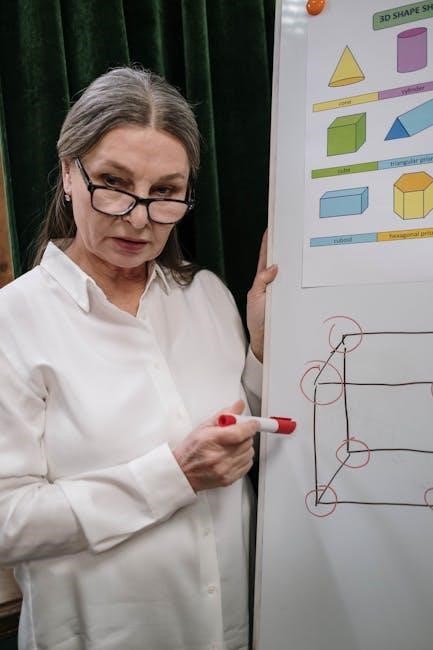
Tools and Resources for Direct Instruction
Math Labs and innovative tools like MoSIM effectively support Direct Instruction by providing practical applications for abstract mathematical concepts and demonstrations.
Utilizing Math Labs with Direct Instruction
Math Labs powerfully complement Direct Instruction by transitioning students from teacher-led demonstrations to hands-on practice. This environment allows for immediate application of concepts, solidifying understanding through active engagement. The Demonstration Approach, central to Direct Instruction, finds a natural extension within the lab setting, where students can replicate modeled procedures.
Labs facilitate a controlled setting for guided practice and immediate feedback, crucial elements of effective Direct Instruction. They bridge the gap between abstract principles and concrete experiences, making mathematical concepts more accessible. Utilizing lab resources allows teachers to observe student application and address misconceptions directly, reinforcing learned skills and promoting mastery. This blended approach maximizes learning outcomes.
MoSIM and Abstract Mathematical Concepts
MoSIM offers a valuable solution for teaching challenging, abstract mathematical concepts that often pose difficulties within traditional classroom settings. Its practical and flexible nature extends learning beyond the limitations of a standard lecture or textbook approach, aligning seamlessly with the principles of Direct Instruction.
By providing a hands-on, interactive experience, MoSIM allows students to visualize and manipulate abstract ideas, strengthening comprehension. This is particularly beneficial when coupled with the explicit modeling and guided practice inherent in Direct Instruction. The successful application of MoSIM demonstrates its capacity to enhance understanding and retention of complex mathematical principles, fostering a deeper, more meaningful learning experience.


Addressing Common Challenges
Direct Instruction can face hurdles like maintaining student engagement and effectively differentiating instruction to meet diverse learning needs within the classroom.
Student Engagement in Direct Instruction
Maintaining active student participation is a recognized challenge within Direct Instruction. While the method’s structured nature provides clarity, it’s crucial to proactively incorporate strategies to prevent passivity. Frequent questioning, even quick checks for understanding, can gauge comprehension and keep students mentally involved.
Varied response methods – think-pair-share, whiteboards, or brief written responses – break up the teacher-led format. Connecting mathematical concepts to real-world applications also boosts relevance and interest. Furthermore, pacing lessons appropriately and providing opportunities for immediate feedback are vital for sustaining engagement throughout the instructional period. A dynamic presentation style from the teacher is also key.
Differentiation within a Direct Instruction Framework
While Direct Instruction is often perceived as rigid, effective differentiation is achievable. Adjustments can be made to the pace of instruction, providing additional practice for students needing more support, or accelerated work for those who grasp concepts quickly.
Scaffolding is crucial; breaking down complex problems into smaller, manageable steps allows all learners to access the material. Varying the complexity of practice problems – offering some at a foundational level and others more challenging – caters to diverse skill levels. Teachers can also provide individualized feedback and targeted interventions during guided practice, ensuring each student receives the support they need to succeed within the structured framework.

Direct Variation Problems and Direct Instruction
Direct variation problems are effectively taught through step-by-step modeling, a core tenet of Direct Instruction, as illustrated by solving examples with changing values.
Solving Direct Variation Problems Step-by-Step
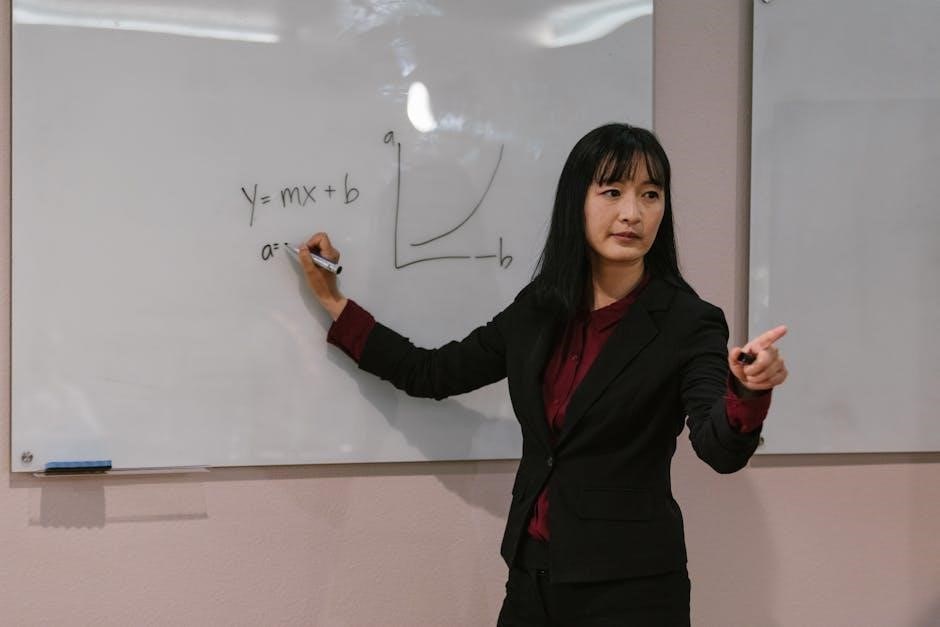
Direct Instruction excels in breaking down complex problems into manageable steps. When tackling direct variation – where one variable changes proportionally to another – begin by establishing the fundamental equation: y = kx.
The initial step involves finding the constant of variation, ‘k’, using given values. For instance, if y = 4 when x = 15, then k = y/x = 4/15.
Once ‘k’ is determined, the equation becomes y = (4/15)x. To solve for ‘y’ when x = 12, simply substitute: y = (4/15)*12. This yields y = 16/5 or 3.2.
Teacher modeling is crucial; demonstrate each step clearly, emphasizing the logical progression. Immediate feedback reinforces understanding and corrects errors promptly.
Applying Direct Instruction to Algebraic Concepts
Direct Instruction provides a solid foundation for mastering algebraic concepts. Begin by explicitly stating the learning objective – for example, solving linear equations. Teacher modeling is paramount; demonstrate each step of the equation-solving process, verbalizing the reasoning behind each manipulation.
Break down complex problems into smaller, sequenced steps. For instance, when solving 2x + 3 = 7, first demonstrate subtracting 3 from both sides, then dividing by 2.
Worked examples are essential, followed by scaffolding and guided practice where students solve similar problems with teacher support.
Immediate feedback allows for quick correction of misconceptions. This structured approach builds confidence and ensures a strong grasp of algebraic principles.
The Role of Curriculum in Direct Instruction
Curriculum selection is vital; Amplify exemplifies next-generation materials supporting Direct Instruction, alongside appropriate resources for formative assessment and structured lessons.
Amplify Curriculum and Direct Instruction
Amplify, a leader in K12 education since 2000, presents a compelling case for curriculum alignment with Direct Instruction principles. Their approach focuses on next-generation learning, seamlessly integrating formative assessment tools that provide teachers with real-time data to inform instruction. This allows for precise monitoring of student understanding during the structured lesson format inherent in Direct Instruction.
The curriculum’s design supports explicit modeling and guided practice, key components of the method. By providing well-defined learning objectives and carefully sequenced materials, Amplify facilitates a teacher-led environment where concepts are clearly demonstrated and students receive immediate feedback. This synergy between curriculum and pedagogy maximizes the effectiveness of Direct Instruction in mathematics classrooms, fostering student mastery.
Selecting Appropriate Materials for Direct Instruction
Effective Direct Instruction hinges on carefully chosen materials. Resources should directly support clearly defined learning objectives and facilitate explicit skill modeling. While many existing materials focus on activities, prioritize those enabling a teacher-led, demonstration-focused approach. Text-based student worksheets are valuable when designed for guided practice and immediate feedback.
Consider materials that allow for worked examples and scaffolding, gradually releasing responsibility to students. Avoid overly complex or ambiguous resources. The goal is clarity and precision. Math Labs, when utilized strategically, can supplement Direct Instruction by providing concrete representations of abstract concepts, reinforcing understanding through hands-on exploration and solidifying skills.
Future Trends in Direct Instruction Mathematics
Technology integration and ongoing research are poised to refine Direct Instruction, enhancing its effectiveness and adaptability within evolving educational landscapes.
Technology Integration
The integration of technology into Direct Instruction mathematics is becoming increasingly prevalent, offering dynamic tools to enhance learning. Interactive whiteboards facilitate clearer teacher modeling and demonstrations, while educational software provides immediate feedback and personalized practice opportunities. Digital platforms allow for efficient delivery of worked examples and scaffolding, catering to diverse learning paces.
Furthermore, technology enables data-driven instruction, allowing teachers to monitor student progress and adjust lessons accordingly. Virtual manipulatives can bridge the gap between abstract concepts and concrete understanding, particularly beneficial when utilizing resources like MoSIM for abstract mathematical ideas. This blend of traditional Direct Instruction principles with modern technology promises to create more engaging and effective learning experiences.
Research and Development in Direct Instruction
Ongoing research continues to refine and validate the effectiveness of Direct Instruction in mathematics. Studies focus on optimizing lesson structures, identifying key components of effective teacher modeling, and exploring strategies for maximizing student engagement. A key area of development involves investigating how to seamlessly integrate technology to enhance the core principles of Direct Instruction.
Furthermore, research explores methods for addressing common challenges, such as differentiation and maintaining student motivation. The success of programs like Amplify curriculum demonstrates a commitment to evidence-based practices. Continued investigation into cognitive load theory and optimal practice schedules will further strengthen the foundation of Direct Instruction as a powerful pedagogical approach.